
SCALE facilitates debate on Societal Readiness of C-ITS Services at the Smart City Expo World Congress 2025 in Barcelona
Between 4 and 6 November 2025, the Smart City Expo World Congress opened its doors to mobility innovators from across the globe at Fira Barcelona — the world’s biggest and most influential event on urban innovation, with 27,104 attendees and 592 speakers from 55 countries.
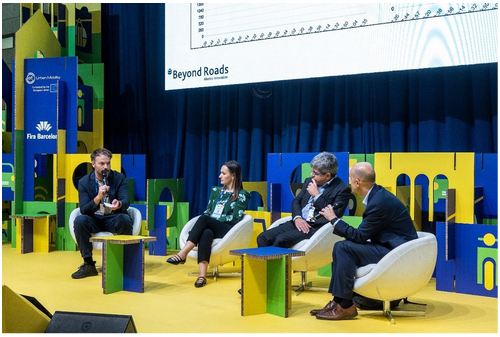
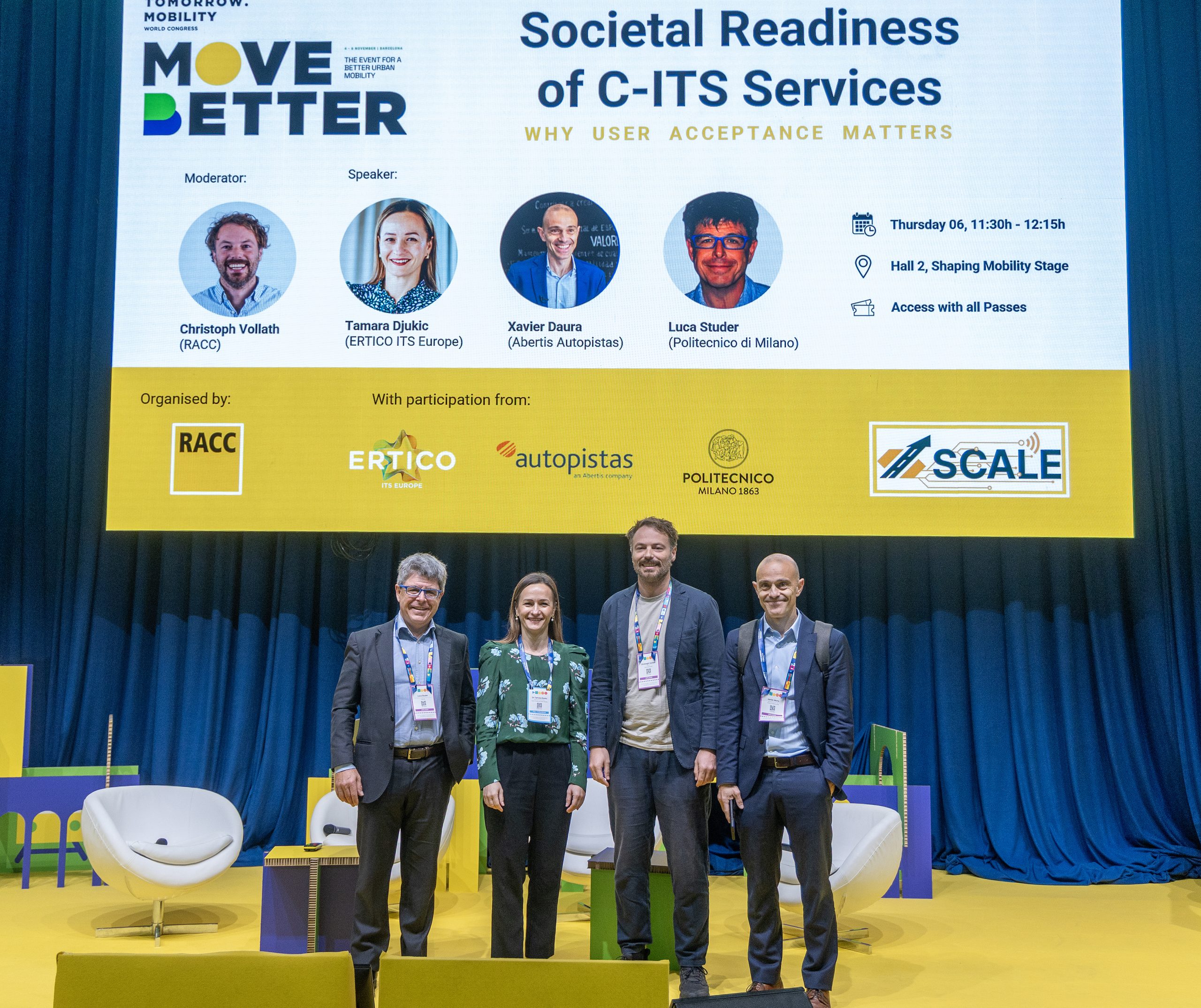
On Thursday, 6 November, as part of the Tomorrow Mobility World Congress programme, SCALE partners Autopistas, Politecnico di Milano and RACC took part in the panel discussion “Societal Readiness of C-ITS Services”. The session, brilliantly moderated by Christoph Vollath, RACC, explored how user acceptance is being integrated into mobility innovation initiatives, challenged current approaches, and proposed concrete ways forward, with two of the panellists representing the project as beneficiaries and with the enriching participation of ERTICO. This topic is highly relevant for SCALE, which places user acceptance and real-world behavioural response at the centre of its large-scale C-ITS deployment activities.
Insights from Autopistas on real-world C-ITS deployment
Xavier Daura, Autopistas presented the company’s current C-ITS activities, many of which are part of the Future Road Lab — a physical testbed near Barcelona supported by Autopistas’ network of living labs. One of the ongoing initiatives involves field tests conducted with OEMs to assess how drivers react to C-ITS messages and how these messages influence road safety and traffic efficiency. Daura showcased videos comparing the driver’s experience when receiving C-ITS notifications directly on the vehicle dashboard versus through a mobile application. He also described how Autopistas plans to measure user reaction times and behavioural adjustments based on KPIs such as traffic flow and speed.
“The objective of C-ITS messages is to enhance road safety. Until autonomous vehicles become a reality, it is crucial that drivers understand and comply with alerts and associated traffic strategies.”
These insights directly contribute to SCALE’s broader mission of understanding how mature C-ITS services can influence behaviour at scale.
Harmonised evaluation approaches from Politecnico di Milano
Luca Studer, Politecnico di Milano, offered an overview of the work carried out within the C-Roads Working Group 3 on Evaluation and Assessment, of which he is chair. The platform brings together experts from across Europe and provides guidelines to harmonise evaluation methodologies for C-ITS field tests. He presented results from past user assessments of three services — Road Works Warning, In-Vehicle Signage and Signalised Intersection — showing that while user acceptance is generally high, willingness-to-pay remains low. However, several stakeholders, including road operators and authorities, attribute significant value to these services due to their measurable impact on safety and traffic performance.
“Drivers have shown to change behaviour in response to the C-ITS messages received. This indicates that the benefit of C-ITS services extends beyond drivers themselves and strongly reinforces the role of road operators, authorities and OEMs.”
This approach resonates with SCALE’s aim to create a shared European knowledge base that supports scalability and long-term adoption of C-ITS solutions.
User acceptance as a behavioural and cultural process
The discussion was complemented by insights from Tamara Djukic, ERTICO, who shared experiences from recent mobility innovation projects, highlighting that user acceptance is not a one-off survey but a long-term cultural and behavioural process. The willingness to adopt new mobility technologies evolves gradually and depends on daily habits, social norms, and local culture. Short-term surveys often capture impressions or intentions, but not real behavioural change. True acceptance requires sustained engagement with users, public authorities and private actors, and must reflect how new technologies integrate into everyday mobility practices.
“Acceptance is often conditioned on actual experience or pilot deployments, infrastructure readiness, regulatory frameworks and collective benefit rather than merely individual intention. In short: user acceptance surveys often measure intention or attitude, not actual adoption or long-term embedding of a service.”
She emphasised the need for holistic approaches that link user perception, enabling policies and collective benefits — a vision fully aligned with SCALE’s work on impact assessment and replication strategies across its Pilot and Operations Sites.
Key questions for the SCALE project
The panel discussion concluded with a number of action items to be addressed within the SCALE project:
- How can we learn from knowledge acquired in similar innovation actions?
- Who are the users that need to accept the service?
- How is acceptance linked to value, willingness-to-pay and price?
- How can we close the user assessment loop by feeding back insights of user acceptance into the refinement of the services?