
What are intelligent and cooperative transportation systems? Why are they getting so much attention?

What if your car could warn you of a hazard before you even see it? Imagine a world where your vehicle can communicate with its surroundings to make your trips safer, more proactive, and cleaner. Today, this vision is within reach thanks to cooperative intelligent transportation systems (C-ITS).
Definition of C-ITS
C-ITS encompasses all communication systems that enable the various participants in a cooperative ecosystem – including intelligent infrastructure and connected vehicles – to exchange information with one another. The information and messages sent via C-ITS operate within a reliable and secure ecosystem. Behind these information exchanges lies a major challenge: message security. How can we ensure their reliability and integrity? An upcoming article will be dedicated to this key aspect of C-ITS.
Technically, this exchange of information can take place over short or long distances. For short-range communication, messages are transmitted via Roadside Units (RUs), which are fixed devices deployed along road infrastructure. RRSs are capable of transmitting and receiving messages over a distance ranging from a few hundred meters to several kilometers, depending on conditions. For long-range communication, messages are sent via the cellular network, allowing users to receive real-time information on a smartphone through the Coopits app.
Coopits is an innovative app, available on Android, that lets you take advantage of various C-ITS services. It overlays navigation apps (Maps, Waze, or others) to provide real-time information from road infrastructure managers. It uses state-of-the-art digital tools to help you drive better (decision support, eco-driving, alerts, notifications of hazardous situations, etc.). Download Coopits and enjoy an onboard traffic computer in your vehicle.
C-ITS: A Cooperative Environment
To understand how the cooperative ecosystem in which C-ITS operate works, we need to look back at its history. Originally, in the 1990s, transportation professionals recognized the potential of emerging information and communication technologies (ICT), which were set to have a significant impact on the mobility sector. In this context, the concept of “ITS” (Intelligent Transport Systems) emerged, encompassing sensor technology, communications, information processing, and control technology. At the time, ITS represented a real technological breakthrough, and many countries saw it as an opportunity to improve traffic safety, the efficiency of various modes of transport, and the environmental and energy impact of mobility.
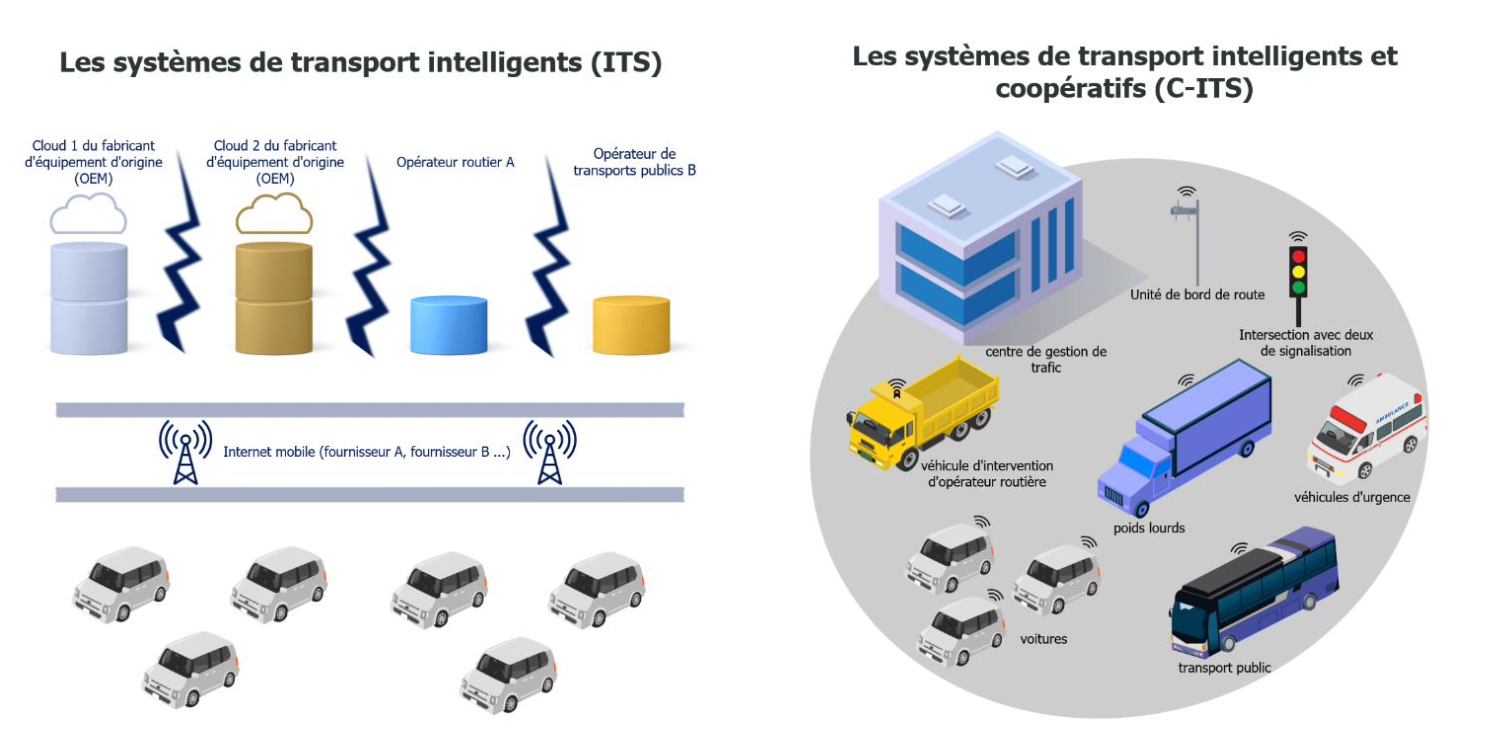
However, very quickly—and despite the revolution these technologies are bringing about—certain limitations of ITS have become apparent. The greatest challenge lies in the transmission of information. The technologies used (cameras, sensors, etc.) can detect events on the roads, but communication of these events passes through various entities before being transmitted to road users in the area (road managers, public transit operators, or even automotive equipment manufacturers’ cloud services). This process does not allow the various entities to communicate with one another, leading to what is known as “siloed” communication. Consequently, these technologies do not enable vehicles, infrastructure, and users to communicate directly with one another. Information exchange is therefore not guaranteed, and these intermediate steps often prolong the time it takes for information to be transmitted, resulting in delays or the information reaching the wrong user.
Thanks to the deployment of wireless transmissions starting in the 2000s, Cooperative Intelligent Transport Systems (C-ITS) began to develop. Building on the foundation of traditional ITS, C-ITS focus on utilizing information and communication technologies within a cooperative system where all participants operate on the same framework.
In addition to I2V (Infrastructure-to-Vehicle) exchanges, the evolution lies in V2X (Vehicle-to- Everything) communications, which include the following interactions:
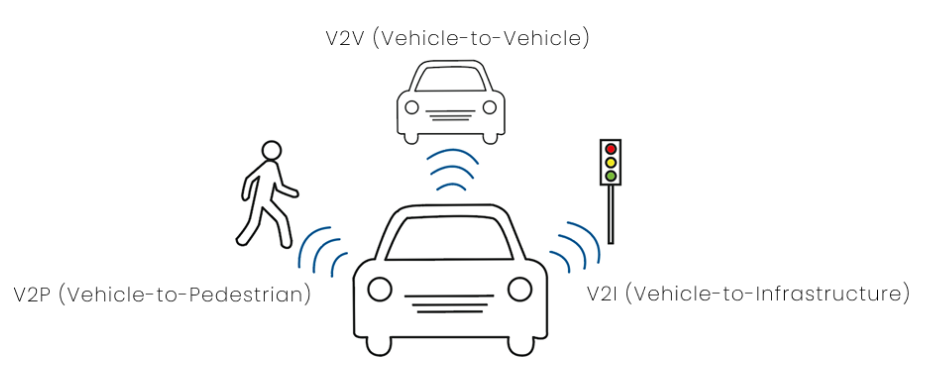
V2X is a vehicular communication system that allows vehicles to exchange information with each other, with infrastructure, and with pedestrians. The primary objectives of V2X are:
- To ensure road safety
- To reduce traffic congestion
- To preserve the environment by saving energy
The fundamental difference between ITS and C-ITS is, therefore, the ability for each actor to communicate directly with one another in order to transmit information as quickly as possible to the right user.
Context : Why are we talking about it?
C-ITS address current sustainable mobility challenges and provide an effective response to them. Today, the road environment faces various difficulties, such as congestion in major cities, safety issues (secondary accidents, minor collisions, protection of vulnerable road users, etc.), increasing traffic volumes, the buildup of driver fatigue and distraction, the safety of road professionals during interventions, and the climate impact of transportation. All of these situations contribute to a rising number of road fatalities.
C-ITS messages help mitigate many of these difficulties by providing services that enhance safety (for passenger vehicles, heavy goods vehicles, and vulnerable road users) and reduce congestion by improving public transport efficiency.
Furthermore, they enable secure and rapid routes for law enforcement and emergency vehicles, ease the challenges posed by heavy goods vehicle (HGV) restrictions, provide driving assistance, and improve the anticipation of hazardous situations. Finally, they allow for driving adaptations that reduce the consumption of natural resources (diesel and gasoline) and lower greenhouse gas emissions.
What are they used for in practice?
C-ITS impact the daily lives of all road users. Whether you are a passenger vehicle or heavy goods vehicle driver, a motorcyclist, a cyclist, or a pedestrian (also classified as vulnerable road users), or even a driver of an emergency vehicle (ambulances, police, Gendarmerie) or a road intervention vehicle, you are all affected by C-ITS. In practical terms, C-ITS are already being tested and used across several regions in France. Currently, six pilot and operational sites are working on various themes that could impact your daily life.
| Pilot Sites | Focus Areas |
| Northwest | Security and Emergency Vehicles Studies use cases (services) that alert road users to the presence of road management, law enforcement, or emergency vehicles (whether moving or stationary). Analyzes traffic light priority situations requested by emergency vehicles, the transmission of instructions from law enforcement to specific designated vehicles, and the broadcasting of messages to variable message signs (VMS) from a mobile vehicle. |
| Southwest | Improving Urban and Peri-urban Mobility Works toward making public transport more efficient and accessible. Works toward improving safety in city centers and peripheral areas. Works toward reducing traffic congestion in these zones. |
| Central-East | Detection of Critical Situations by Automated Vehicles Conducts research on the connectivity of Automated and Connected Vehicles (ACV). Tests complex scenarios and use cases within tunnels. |
| Northeast | Logistics Facilitates the movement of heavy goods vehicles (HGVs) in interurban and urban environments. Develops use cases to provide information on available spaces at rest areas and delivery zones, as well as alerts regarding routes prohibited for the transport of dangerous goods and traffic restrictions during “inclement weather plans” (plans intempéries). |
| Southeast | Vulnerable Road Users (VRUs) Proposes use cases to improve the safety of vulnerable road users (motorcyclists, cyclists, pedestrians, etc.). Focuses specifically on intersections between departmental roads and greenways (voies vertes), as well as bridge crossings with specific weight limits. |
| Ile-de-France | Hybridization and Services Utilizes a vehicle-centric approach led by the Renault Group (Ampère Software Technology) to enhance how the vehicle processes hazardous situations. Provides services for the Coopits application. |
Why is this important for road users?
As highlighted previously, C-ITS services enable a significant improvement in mobility across several key dimensions:
- Safety Dimension → Fewer surprises, fewer accidents.
- Driving Assistance Dimension → More guidance, better reflexes.
- Travel Facilitation Dimension → More information, greater speed, and increased efficiency.
- Environmental Dimension → Fewer unnecessary stops, less wasted resources. In an era where the world is hyper-connected and where travel is either a necessity or a choice, every user can see their daily mobility improved thanks to C-ITS.
Already a Reality: Deployment on the Roads
C-ITS are not just a futuristic concept; they are currently being deployed on French and European roads.
In France, the rollout of “mature” use cases has already begun across various pilot sites. Here are several concrete examples you might encounter during your daily commutes:
- Roadworks Warnings – Mobile Roadworks: Sends information regarding the closure of a partial or full lane due to a scheduled mobile construction site.
- Roadworks Warnings – Winter Maintenance: Alerts drivers that a vehicle is currently plowing or salting the road, allowing them to adapt their driving behavior accordingly.
- Hazardous Situation Notifications – Animal or Person on the Road: Sends a signal to drivers to inform them that a person (road worker, etc.) or an animal is on the roadway.
- Hazardous Situation Notifications – Accident Zone: Notifies drivers that an accident has occurred on the road network.
- Hazardous Situation Notifications – Traffic Jam: Transmits information that a traffic jam has been detected, including its position, length, and the lanes affected.
- Hazardous Situation Notifications – Wrong-Way Driving Alert: Warns drivers in the area that they may encounter a vehicle traveling in the wrong direction (the primary goal is to warn oncoming traffic, not the wrong-way driver).
- Hazardous Situation Notifications – Stationary Vehicle: Warns approaching drivers of the presence of immobilized or broken-down vehicles ahead that pose a safety risk.
- Signalized Intersections (Traffic Lights) – Green Light Optimal Speed Advisory (GLOSA): Sends speed recommendations to help drivers approach and cross signalized intersections safely and efficiently (catching the “green wave”).
- Signalized Intersections (Traffic Lights) – Emergency Vehicle Priority: Assists in controlling traffic light phases to facilitate the passage of an emergency vehicle and informs surrounding drivers of the priority status.
These C-ITS messages can be received directly by your vehicle (if it is equipped with the necessary onboard technology to send and receive messages) or via cellular network through the Coopits application. Some car manufacturers, such as Volkswagen, already include technology capable of exchanging C-ITS messages in their vehicles. In these cases, the alerts are displayed directly on the vehicle’s dashboard.
The Value of SCALE
The SCALE project stands as a major European player facilitating the selection, deployment, and industrialization of various C-ITS services. It brings together several partner countries—France, Italy, Spain, Austria (Graz), and Hungary (associate partner)—with the primary objective of expanding the existing C-ITS use case catalog and deploying these services at scale.
By removing the final barriers to the industrialization of C-ITS, SCALE supports the widespread adoption of these technologies. In doing so, it contributes to the development of a new generation of smart mobility services designed to serve all road users.
With the project having launched in September 2024, a key milestone is set for March 2026. At this stage, all project partners will select the specific use cases to be developed and carried through to full deployment over the course of the project.
Every selected use case must undergo a series of in-depth analyses conducted by various entities within the project to evaluate its deployment feasibility. This selection process will be the subject of a dedicated upcoming article!