

ITS Spain organised an online course on Cooperative Intelligent Transport Systems and C-ITS technologies

On 23 June, ITS Spain organised an online course dedicated to Cooperative Intelligent Transport Systems (C-ITS), a key technology for advancing towards safer, more connected, efficient and sustainable mobility. The training, delivered by Diego Bernárdez, BRAIN4Mobility | CTAG, enabled participants to gain an understanding of the main concepts, technologies and applications associated with cooperative communication between vehicles, infrastructure and other road users.
An overview of Cooperative Intelligent Transport Systems technologies and applications

The course covered the main fundamentals of cooperative systems, starting with the evolution of mobility and the development of connected and automated vehicles. Throughout the training, the different V2X communication modes were presented, including V2V (Vehicle-to-Vehicle), V2I (Vehicle-to-Infrastructure), V2P (Vehicle-to-Pedestrian) and V2N (Vehicle-to-Network).
The course also examined the main technologies and architectures enabling the deployment of these systems, as well as various C-ITS applications and services, including vulnerable road user protection, cooperative intersections, traffic signal priority and GLOSA (Green Light Optimal Speed Advisory).
Another section of the training focused on smart and cooperative infrastructure, highlighting the role of roads and infrastructure as elements capable of sensing and processing information and cooperating with vehicles. Key aspects such as security, cybersecurity and Public Key Infrastructure (PKI) were also addressed. These are essential to ensuring the authenticity, integrity and trustworthiness of cooperative communications.
SCALE: driving the deployment of C-ITS in Europe
The training also featured a presentation of the European SCALE project (Strengthening C-ITS Adoption and Lining-up across Europe), whose objective is to help overcome existing barriers and support the effective and coordinated deployment of C-ITS services across Europe.
The project brings together numerous European partners and includes several pilot sites to demonstrate and validate cooperative solutions under real-world conditions.
As a precedent, during the 16th European ITS Congress, held in Seville in May 2025, CTAG designed and deployed a C-ITS corridor focused on the demonstration of cooperative services. This initiative helped advance the integration of cooperative technologies and assess their benefits for mobility, while also providing an example of how such solutions can be designed, deployed and brought into operation within a very short timeframe.
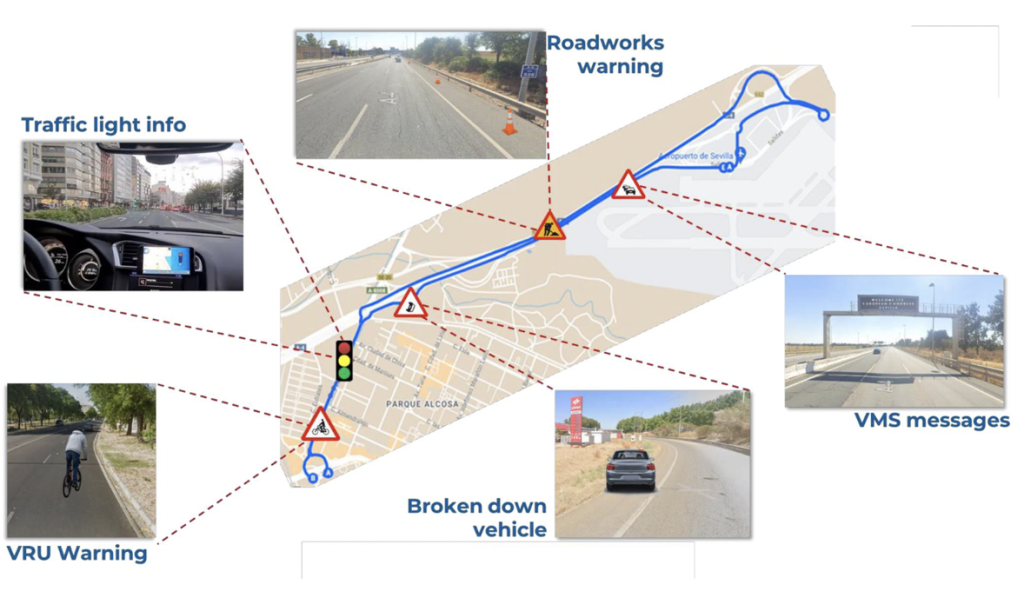
Figure. Corridor C-ITS Seville. May 2025
The presentation provided participants with first-hand insight into the project’s objectives, as well as the activities planned for the Spanish pilot and the contribution of Cooperative Intelligent Transport Systems to safer, more efficient and connected mobility.
C-Roads: European cooperation for connected mobility
The course concluded with a presentation of the C-Roads Platform, a European initiative aimed at coordinating and harmonising the deployment of C-ITS services across Europe. Its main objectives are to connect the different European C-ITS deployments, develop common technical specifications and conduct interoperability testing, including the validation of services along cross-border corridors.
The training highlighted the importance of cooperation between public authorities, vehicle manufacturers, technology providers and infrastructure operators to ensure that cooperative systems can operate in an interoperable and consistent manner.
In this context, C-Roads has contributed to the development of common specifications and the deployment of C-ITS services both on interurban roads and, increasingly, in urban environments. Key conclusions from the session included the potential of these technologies to provide users with real-time information, support mobility management and facilitate the integration of services related to public transport, emergency vehicles and the management of urban access restrictions.
Through this training, ITS Spain continues to promote knowledge and raise awareness of new technologies applied to transport, bringing professionals and sector stakeholders closer to the latest trends and developments in connected, cooperative and automated mobility.