

SCALE drives the deployment of Cooperative Intelligent Transport Systems (C-ITS) in Spain
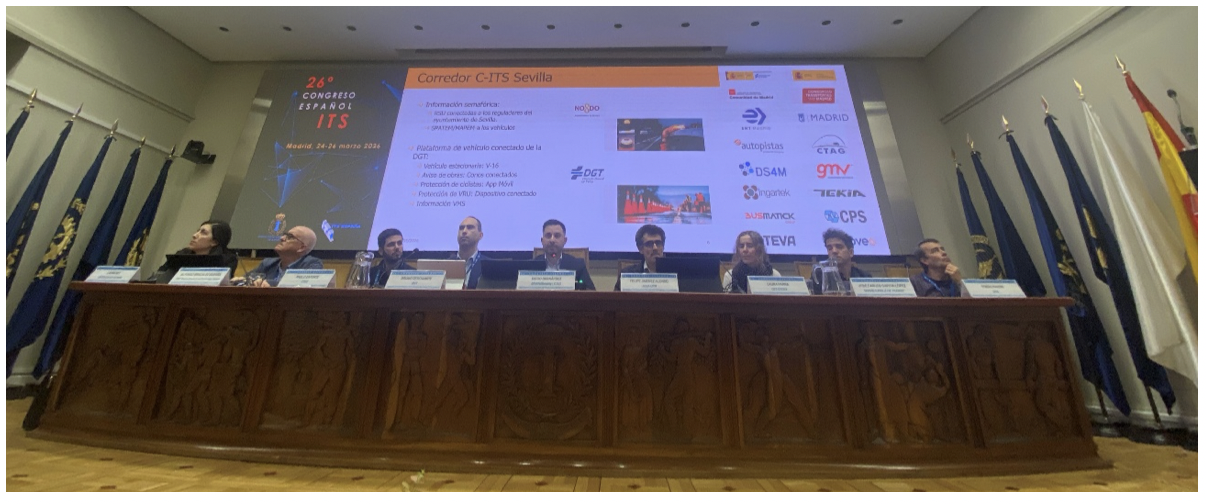
As part of the 26th Spanish ITS Congress, organised by ITS Spain and held in Madrid on 22 March 2026, a session was dedicated to the European SCALE project (Strengthening C-ITS Adoption and Lining-up across Europe), during which the main progress achieved and planned activities across the different Spanish pilot sites were presented. The session was coordinated by Diego Bernárdez, from BRAIN4Mobility|CTAG and brought together representatives from various organisations involved in the deployment of cooperative systems in Spain.
The session began with an introduction by Bruno Deschamps, from the Directorate-General for Traffic (DGT), who briefly presented the objectives and scope of SCALE, as well as its contribution to the deployment and adoption of Cooperative Intelligent Transport Systems (C-ITS) services across Europe. The presentation provided context for the activities planned in Spain and highlighted the importance of moving towards more connected, interoperable and safer mobility.
The four Spanish pilot sites within the project were then presented: Madrid-Centro, Galicia, Catalonia and the Basque Country. These pilots combine activities in both urban and interurban environments and adapt cooperative technologies to the specific needs of each territory.
The Madrid-Centro pilot focuses on deploying extensive C-ITS infrastructure and validating services related to accidents, congestion, stationary vehicles, roadworks, weather conditions and vulnerable road users. Particular emphasis is placed on technologies related to Connected and Automated Mobility (CCAM), with bidirectional V2X communications between automated vehicles and traffic management centres.
In Galicia, the pilot aims to extend the coverage of C-ITS services, particularly in urban environments, through applications related to roadworks, parking and loading/unloading areas, tunnels, obstacles and stationary vehicles. The activities include the use of information from sources such as the National Access Point (NAP) and DGT 3.0, as well as the deployment of infrastructure at strategic access points to cities and in low-emission zones.
The Catalonia pilot focuses on improving road safety through cooperative communication and real-time information exchange. Its main use cases include the detection and protection of vulnerable road users, particularly cyclists, as well as wildlife detection, with the aim of anticipating potentially hazardous situations.
The Basque Country pilot, with activities in Bizkaia and Gipuzkoa, stands out for its GLOSA (Green Light Optimised Speed Advisory) application, which recommends speeds to promote smoother traffic flow and reduce stops, emissions and congestion. It also includes vulnerable road user protection services and new use cases related to slow-moving vehicles, roadworks, parking, wrong-way driving and cooperative driving assistance.
The session also highlighted the contribution of SICE to the deployment of the infrastructure required to make C-ITS services a reality. Its involvement is particularly relevant to the implementation of Roadside Units (RSUs) and the integration of the different technological components that enable cooperative communication between infrastructure and vehicles. This work helps to translate technological developments into real-world operational environments and ensures that the deployed infrastructure can support the various services and use cases envisaged within the pilots.
The session concluded with a presentation by CEDEX on the importance of Public Key Infrastructure (PKI) systems. CEDEX, as the public institution responsible within the project for analysing the security and trust requirements of cooperative systems in relation to PKI, is conducting this work together with CTAG, which is responsible for the technical coordination of the C-ITS deployment in Spain. Their work is essential to harmonise the different pilot projects and ensure that the services are interoperable, scalable and compatible with European standards, with a view to their future deployment.
Overall, the session demonstrated the potential of SCALE to accelerate the deployment of cooperative systems in Spain and to contribute to a safer, more connected, interoperable and efficient mobility ecosystem.